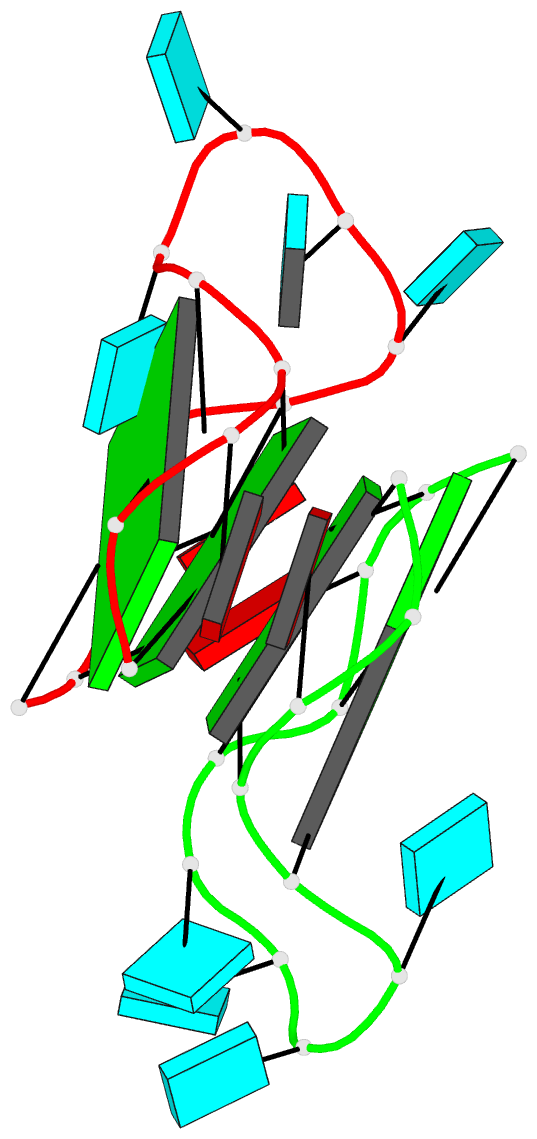
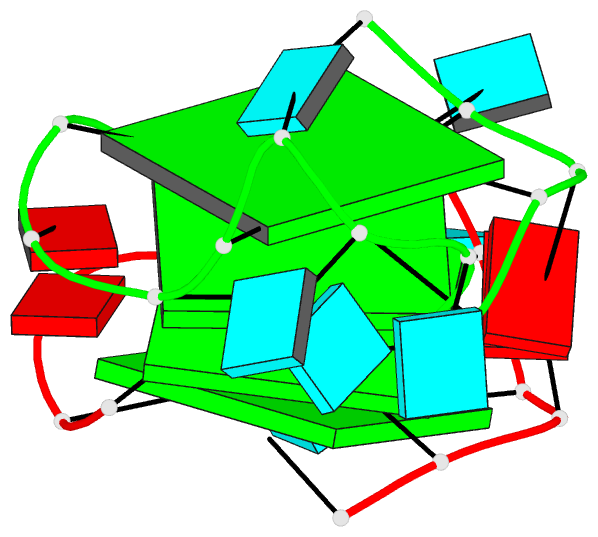
Summary information and primary citation
- PDB-id
-
1my9;
DSSR-derived features in text and
JSON formats
- Class
- RNA
- Method
- NMR
- Summary
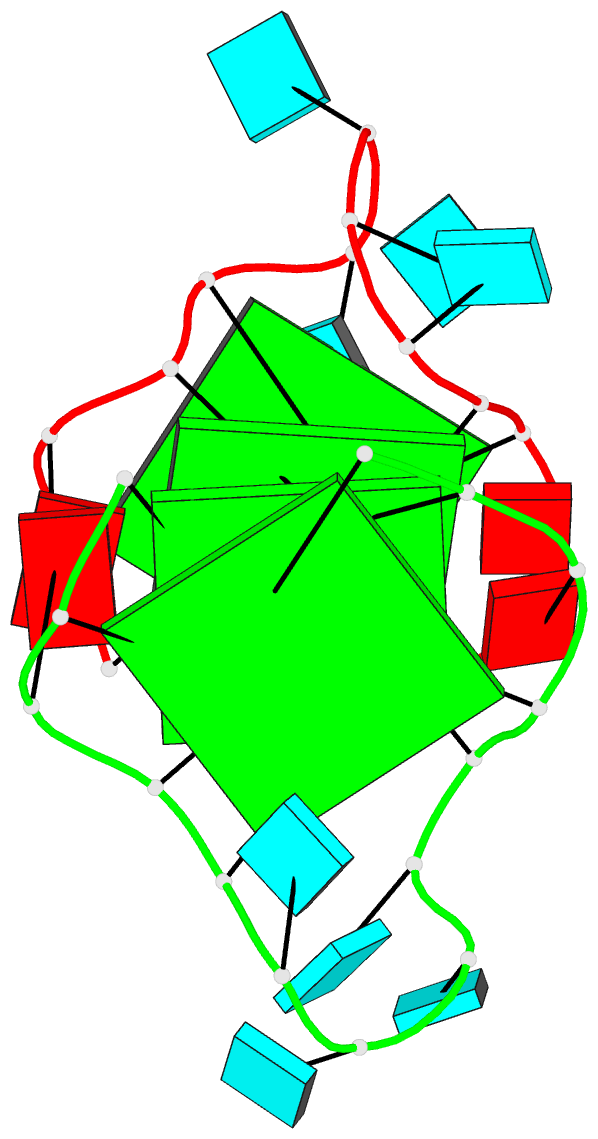
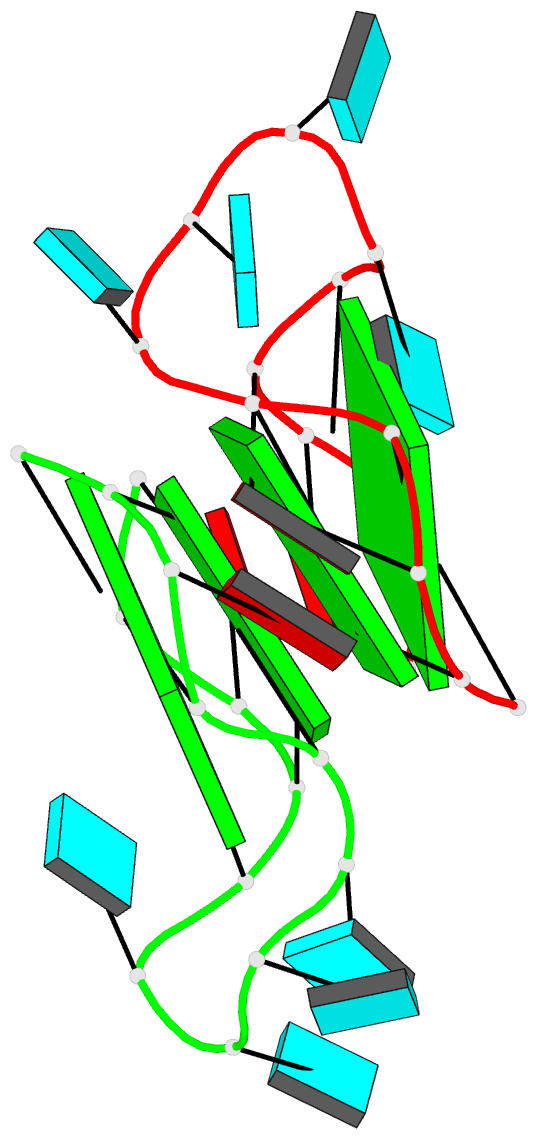
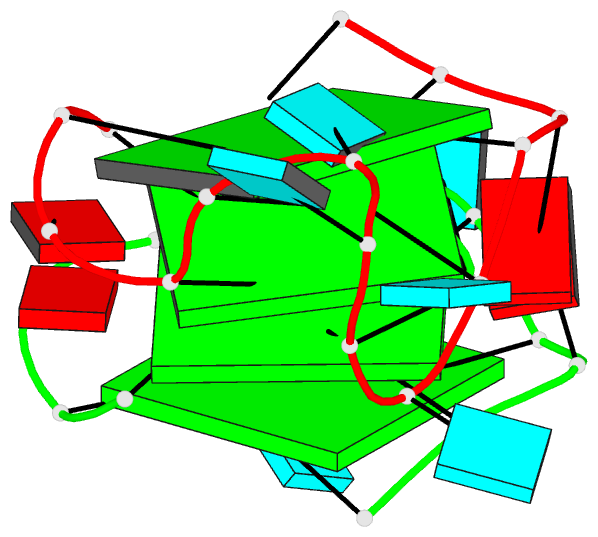
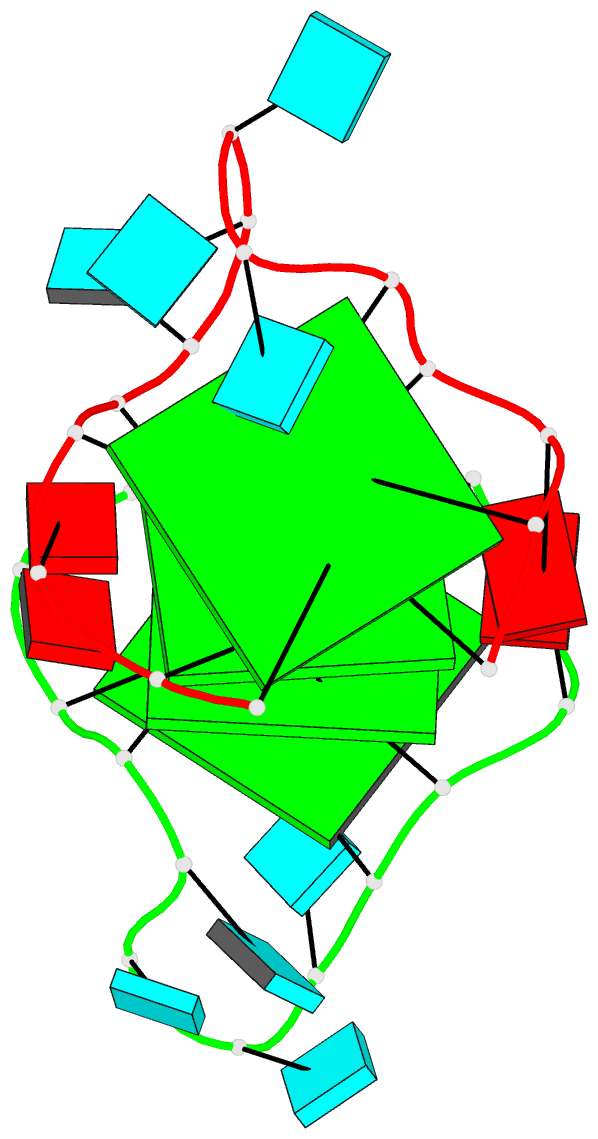
- Solution structure of a k+ cation stabilized dimeric
RNA quadruplex containing two g:g(:a):g:g(:a) hexads,
g:g:g:g tetrads and uuuu loops
- Reference
-
Liu H, Matsugami A, Katahira M, Uesugi S (2002):
"A
Dimeric RNA Quadruplex Architecture Comprised of Two
G:G(:A):G:G(:A) Hexads, G:G:G:G Tetrads and UUUU
Loops." J.Mol.Biol., 322,
955-970. doi: 10.1016/S0022-2836(02)00876-8.
- Abstract
- Using CD and NMR, we determined the structure of an RNA
oligomer, r(GGAGGUUUUGGAGG) (R14), comprising two GGAGG
segments joined by a UUUU segment. A modified quadruplex
structure was observed for r(GGAGGUUUUGGAGG) in solution
even in the absence of K(+). An unusually stable dimeric
RNA quadruplex architecture formed from two strands of
r(GGAGGUUUUGGAGG) at low K(+) concentration is reported
here. In each strand of r(GGAGGUUUUGGAGG), two sets of
successive turns in the GGAGG segments and turns at both
ends of the UUUU loops drive four G-G steps to align in a
parallel manner, a core with two stacked G-tetrads being
formed. Two adenine bases bind to two edges of one G:G:G:G
tetrad through the sheared G:A mismatch augmenting the
tetrad into a G:G(:A):G:G(:A) hexad. Thus, one molecule of
r(GGAGGUUUUGGAGG) folds into a modified quadruplex
comprising a G:G:G:G tetrad, a UUUU double-chain reversal
loop and a G:G(:A):G:G(:A) hexad. Two such molecules
further associate by stacking through the dimeric
hexad-hexad interface with a rotational symmetry. The
ribose rings of most nucleotides take S (close to C2'-endo)
puckering, which is unusual for an RNA. K(+) can increase
the stability of this quadruplex structure; the number of
bound K(+) was estimated from the results of the titration
experiment. Besides G:G and G:A mismatches, a network of
hydrogen bonds including O4'-NH(2) and C-H..O hydrogen
bonds, and the extensive base stacking contribute to the
high thermodynamic stability of R14. Our results could
provide the stereochemical and thermodynamic basis for
elucidating the biological role of the GGAGG-containing RNA
segments abundantly existing in various RNAs. Relevance to
quadruplex-mediated mRNA-FMRP binding and HIV-1 genome RNA
dimerization is discussed.