Summary information and primary citation
- PDB-id
-
1p26;
DSSR-derived features in text and
JSON formats
- Class
- DNA
- Method
- X-ray (2.92 Å)
- Summary
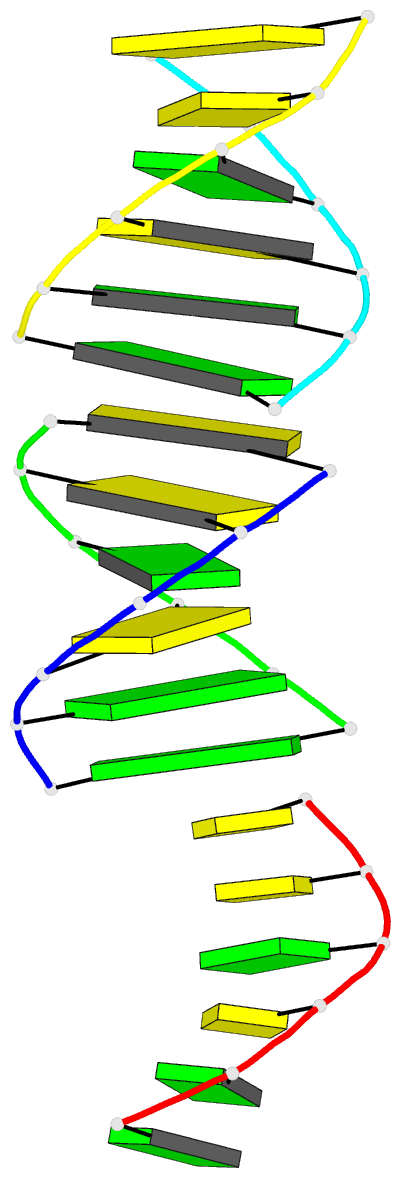
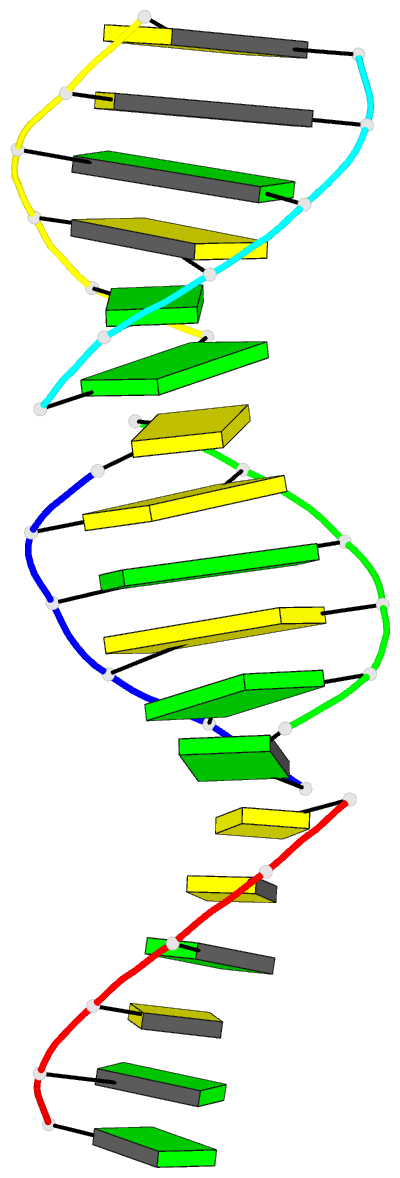
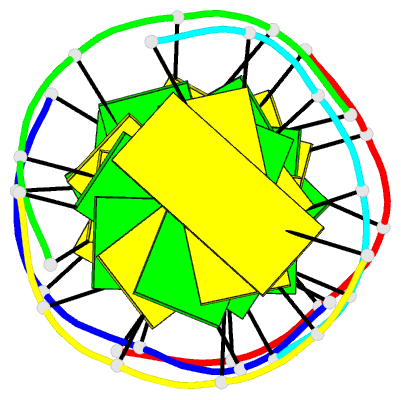
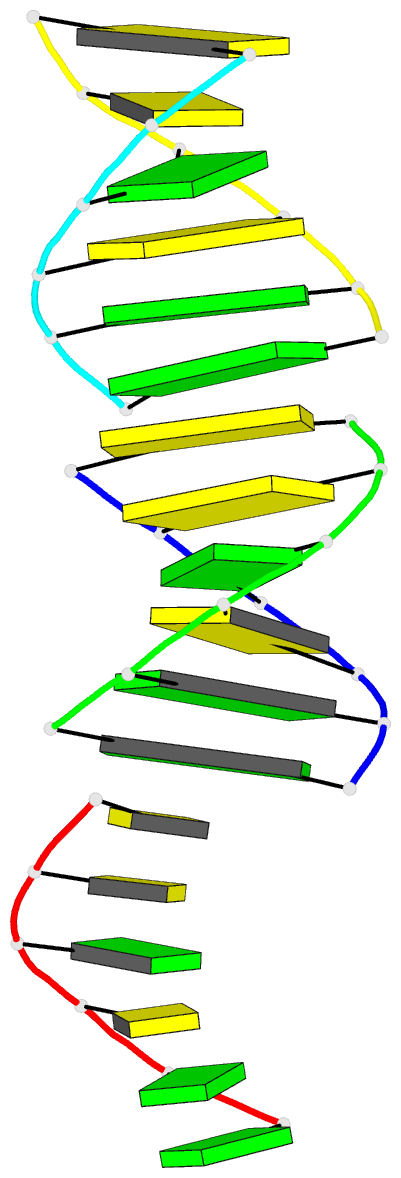
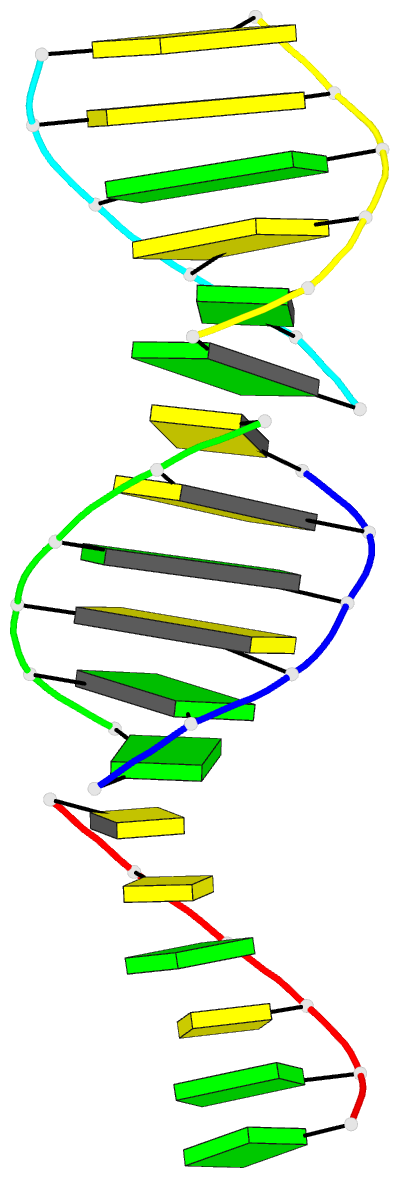
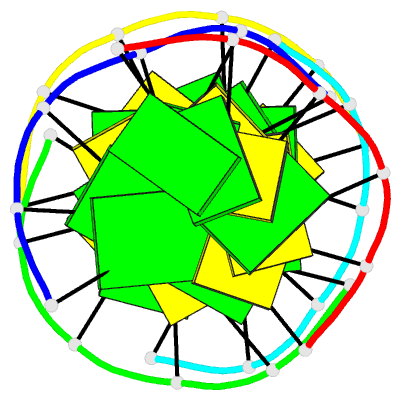
- Crystal structure of zinc(ii)-d(ggcgcc)2
- Reference
-
Labiuk SL, Delbaere LT, Lee JS (2003): "Cobalt(II),
nickel(II) and zinc(II) do not bind to intra-helical N(7)
guanine positions in the B-form crystal structure of
d(GGCGCC)." J.Biol.Inorg.Chem.,
8, 715-720. doi: 10.1007/s00775-003-0473-4.
- Abstract
- Three novel X-ray crystal structures for the DNA
hexamer d(GGCGCC) in the B-form complexed to divalent
cobalt, nickel and zinc ions have been determined to a
resolution of 2.9-3.0 A. The structures were isomorphous
and had five DNA strands and five metal cations per
asymmetric unit. In all three cases, divalent metal cations
were coordinated only to the terminal guanine residue at
the N(7) position, with no metal ions binding to
non-terminal guanine positions. Water molecules bound to
the metal cations interacted with neighboring guanine
residues 3' to the ones to which the cations were
coordinated, affecting the propeller twist. Even though DNA
occupied only about 35% of the unit cell volume, it is
interesting that the few interactions involving the metal
cations were sufficient to stabilize the crystal lattice.
As well as lending support to the proposal that these
metals do not coordinate to B-DNA in a stable manner, the
results presented here also extend the crystallographic
evidence for this phenomenon to the GGC and CGC sequences
for all three metal cations.