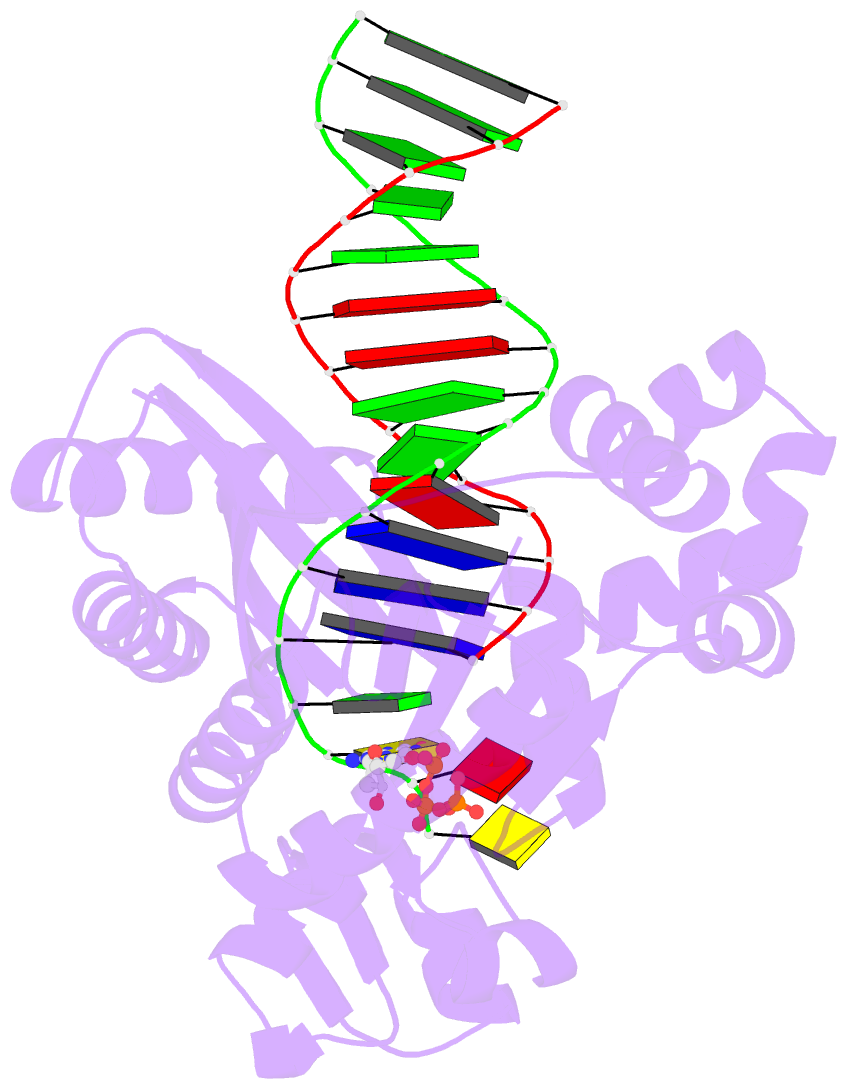
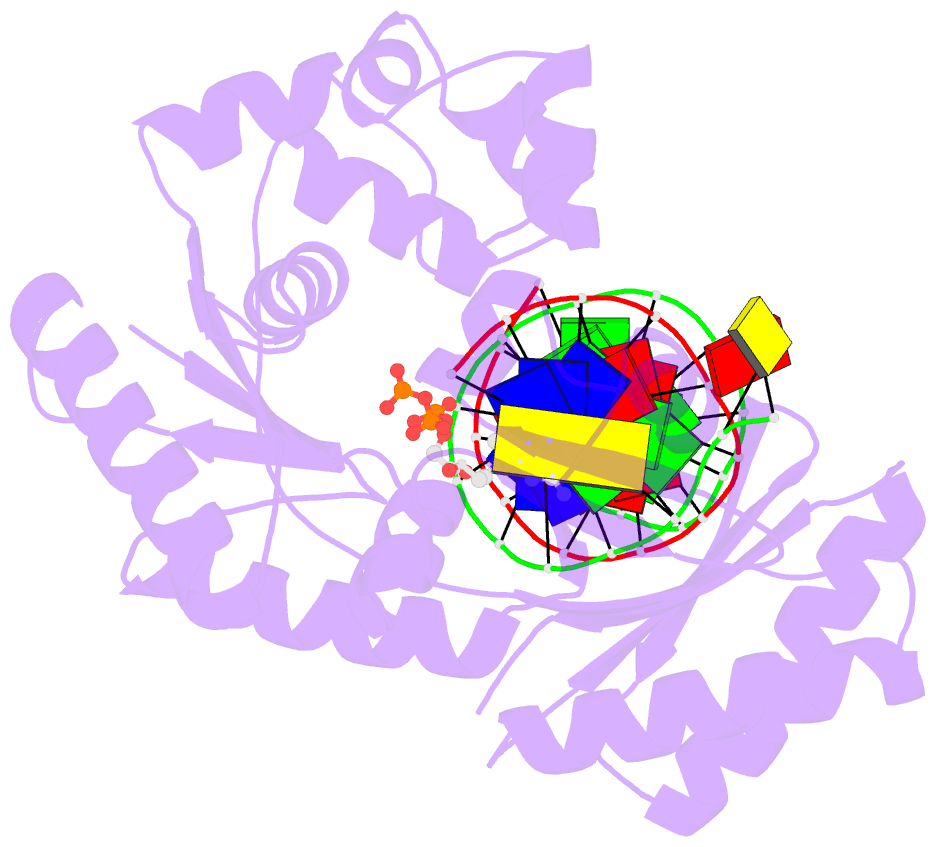
Summary information and primary citation
- PDB-id
-
2r8g;
DSSR-derived features in text and
JSON formats
- Class
- replication, transferase-DNA
- Method
- X-ray (2.7 Å)
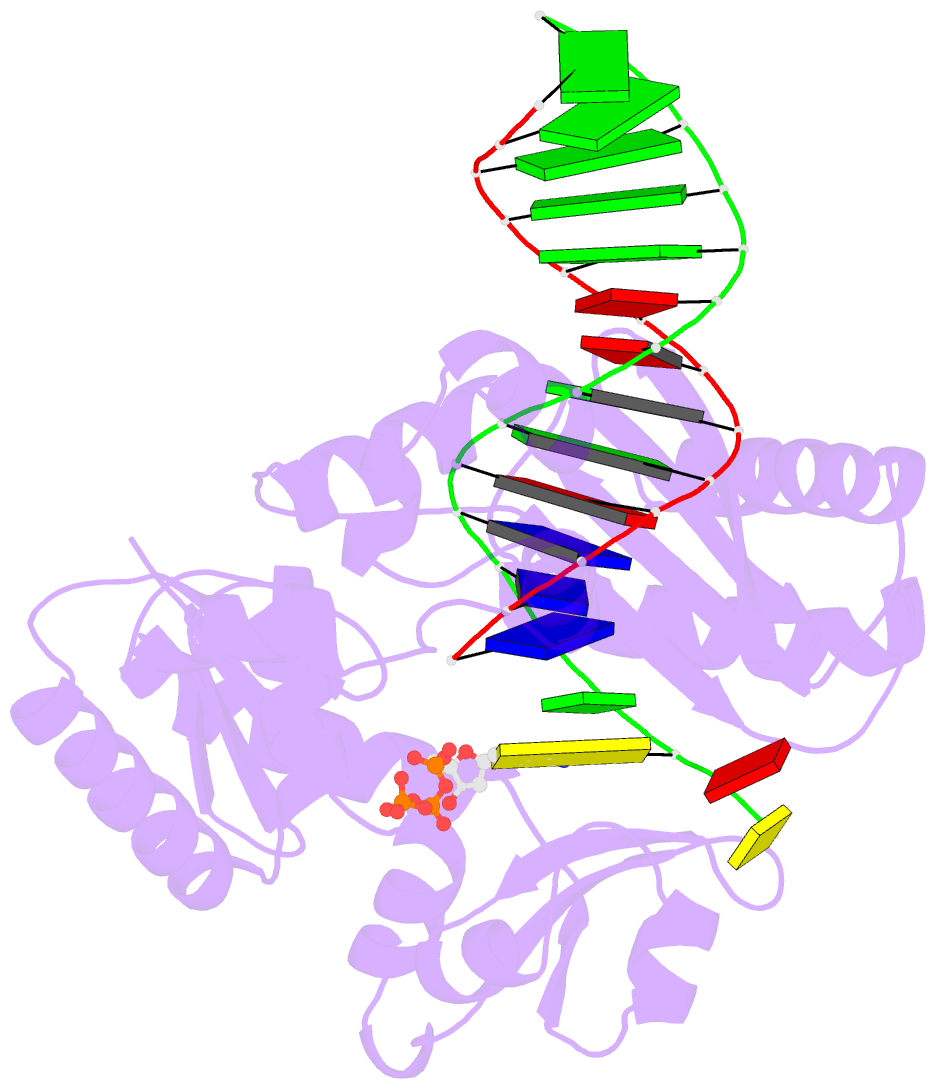
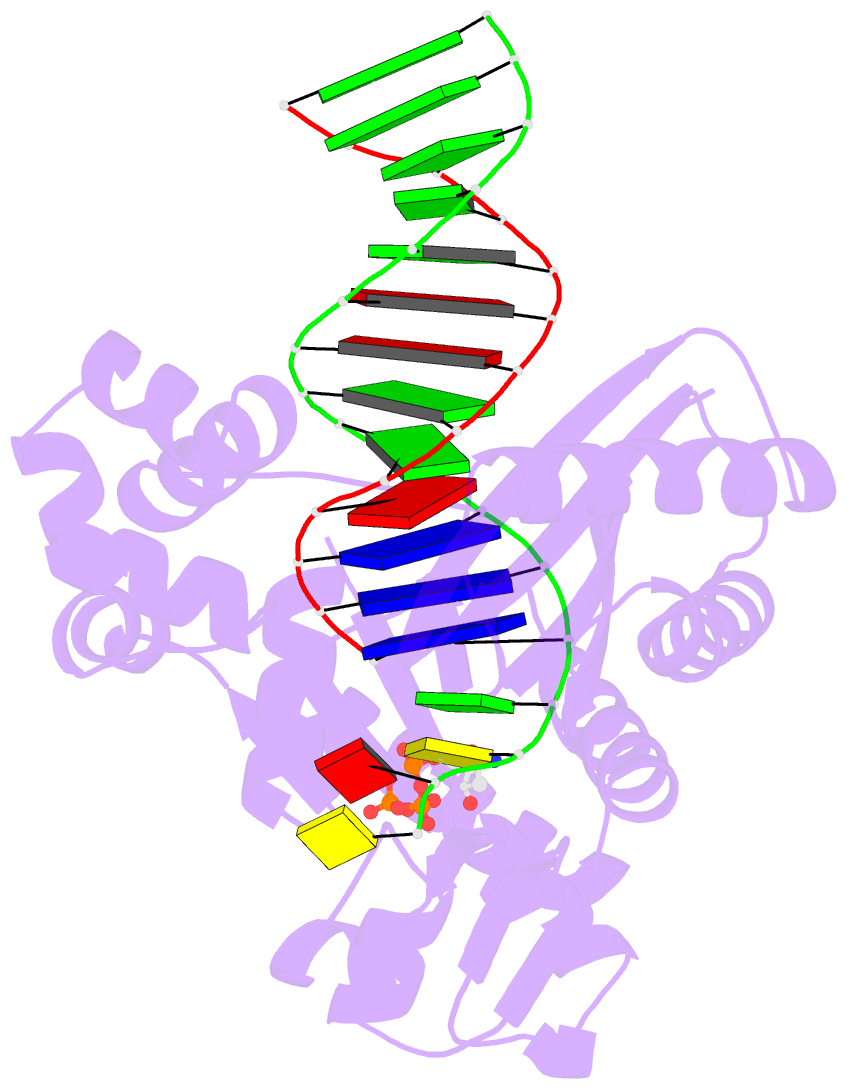
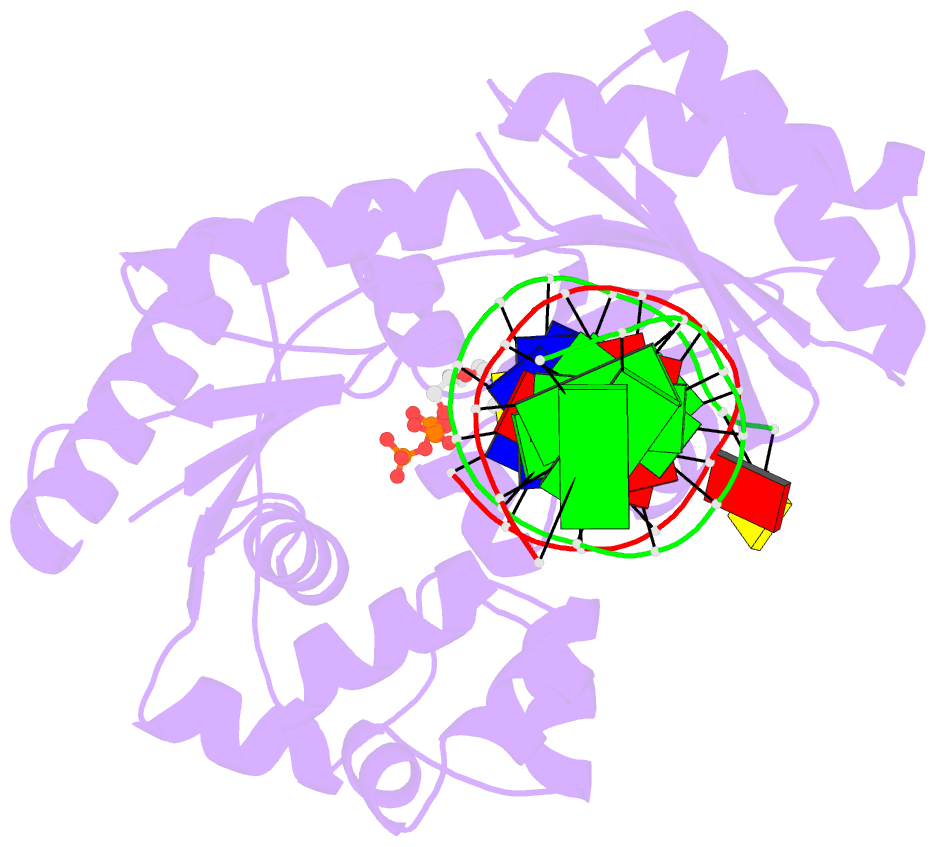
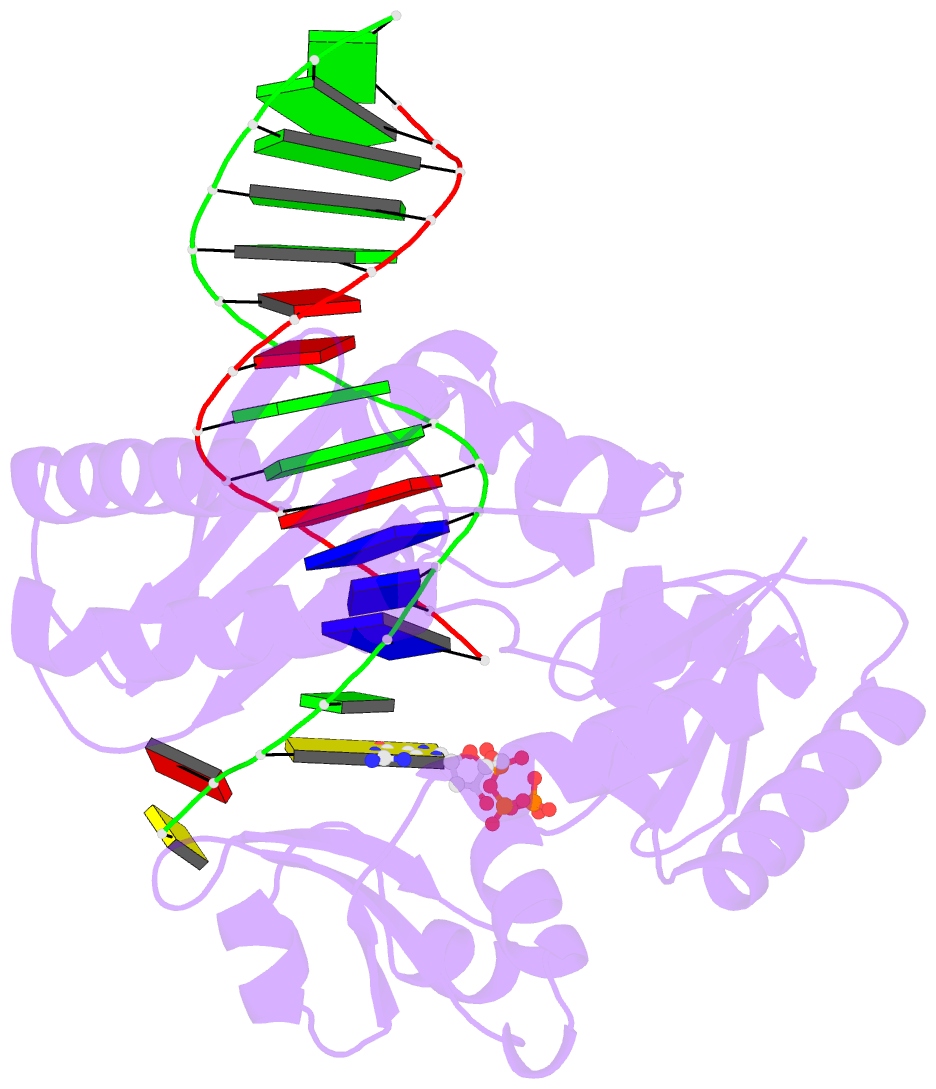
- Summary
- Selectivity of nucleoside triphosphate incorporation
opposite 1,n2-propanodeoxyguanosine (pdg) by the sulfolobus
solfataricus DNA polymerase dpo4 polymerase
- Reference
-
Wang Y, Musser SK, Saleh S, Marnett LJ, Egli M, Stone MP
(2008): "Insertion
of dNTPs opposite the 1,N2-propanodeoxyguanosine adduct
by Sulfolobus solfataricus P2 DNA polymerase IV."
Biochemistry, 47, 7322-7334.
doi: 10.1021/bi800152j.
- Abstract
- 1, N (2)-Propanodeoxyguanosine (PdG) is a stable
structural analogue for the 3-(2'-deoxy-beta- d-
erythro-pentofuranosyl)pyrimido[1,2-alpha]purin-10(3 H)-one
(M 1dG) adduct derived from exposure of DNA to base
propenals and to malondialdehyde. The structures of ternary
polymerase-DNA-dNTP complexes for three template-primer DNA
sequences were determined, with the Y-family Sulfolobus
solfataricus DNA polymerase IV (Dpo4), at resolutions
between 2.4 and 2.7 A. Three template 18-mer-primer 13-mer
sequences,
5'-d(TCACXAAATCCTTCCCCC)-3'.5'-d(GGGGGAAGGATTT)-3'
(template I),
5'-d(TCACXGAATCCTTCCCCC)-3'.5'-d(GGGGGAAGGATTC)-3'
(template II), and
5'-d(TCATXGAATCCTTCCCCC)-3'.5'-d(GGGGGAAGGATTC)-3'
(template III), where X is PdG, were analyzed. With
templates I and II, diffracting ternary complexes including
dGTP were obtained. The dGTP did not pair with PdG, but
instead with the 5'-neighboring template dC, utilizing
Watson-Crick geometry. Replication bypass experiments with
the template-primer
5'-TCACXAAATCCTTACGAGCATCGCCCCC-3'.5'-GGGGGCGATGCTCGTAAGGATTT-3',
where X is PdG, which includes PdG in the 5'-CXA-3'
template sequence as in template I, showed that the Dpo4
polymerase inserted dGTP and dATP when challenged by the
PdG adduct. For template III, in which the template
sequence was 5'-TXG-3', a diffracting ternary complex
including dATP was obtained. The dATP did not pair with
PdG, but instead with the 5'-neighboring T, utilizing
Watson-Crick geometry. Thus, all three ternary complexes
were of the "type II" structure described for ternary
complexes with native DNA [Ling, H., Boudsocq, F.,
Woodgate, R., and Yang, W. (2001) Cell 107, 91-102]. The
PdG adduct remained in the anti conformation about the
glycosyl bond in each of these threee ternary complexes.
These results provide insight into how -1 frameshift
mutations might be generated for the PdG adduct, a
structural model for the exocylic M 1dG adduct formed by
malondialdehyde.