Summary information and primary citation
- PDB-id
-
3pw4;
DSSR-derived features in text and
JSON formats
- Class
- transferase-DNA
- Method
- X-ray (2.9 Å)
- Summary
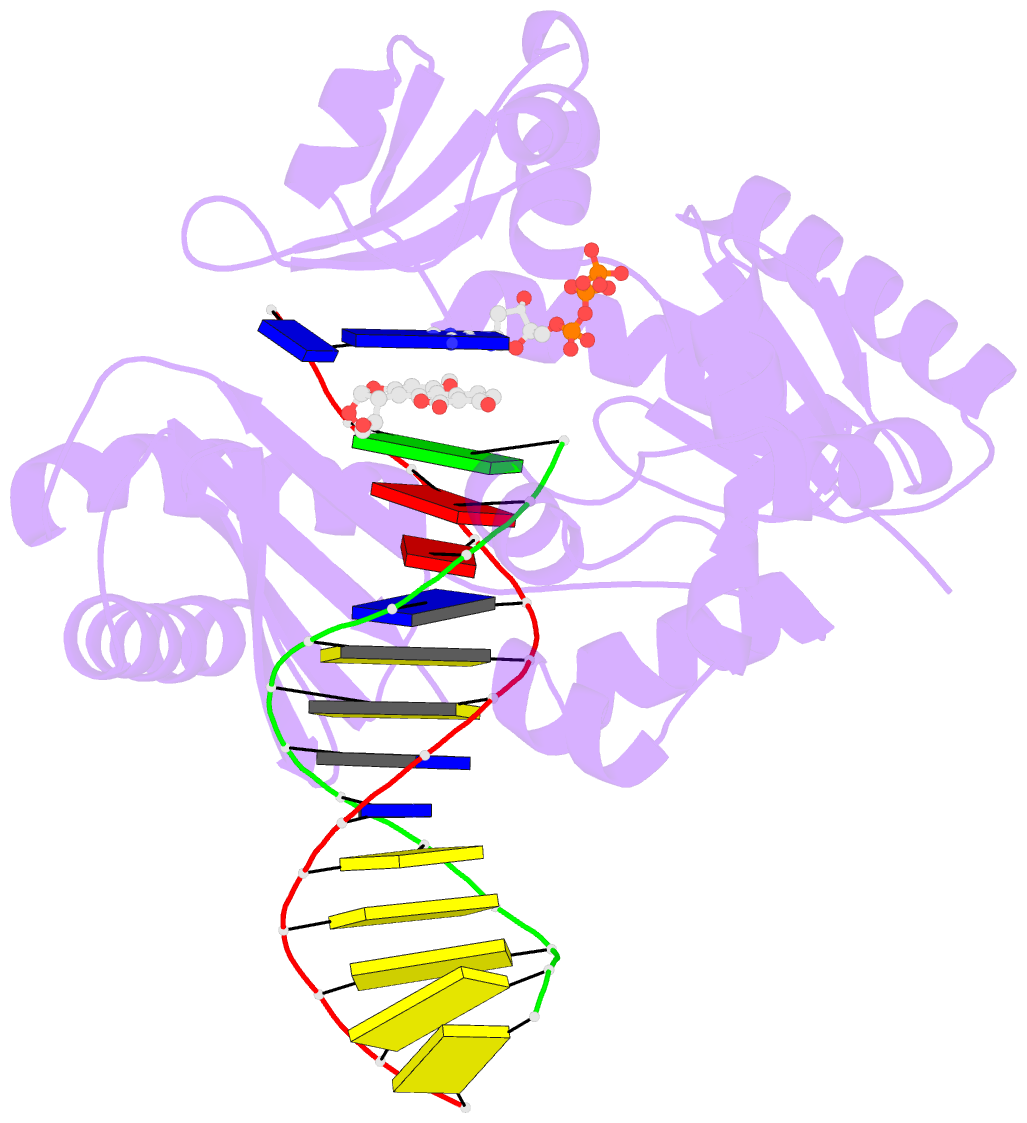
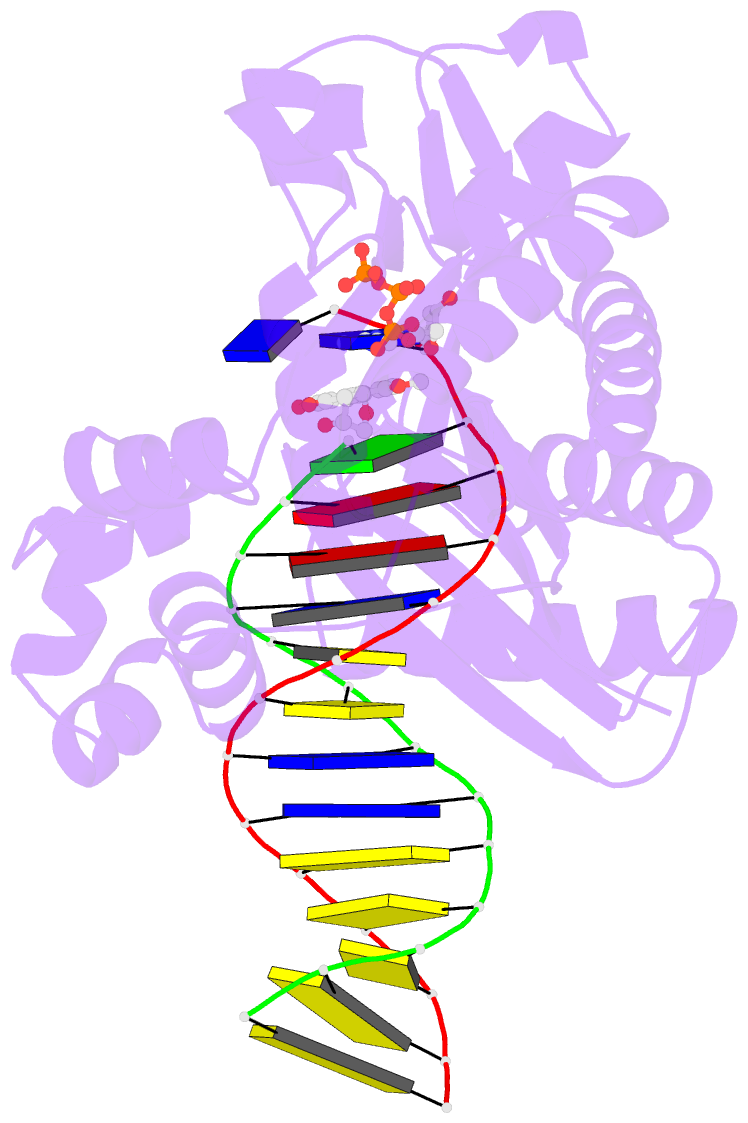
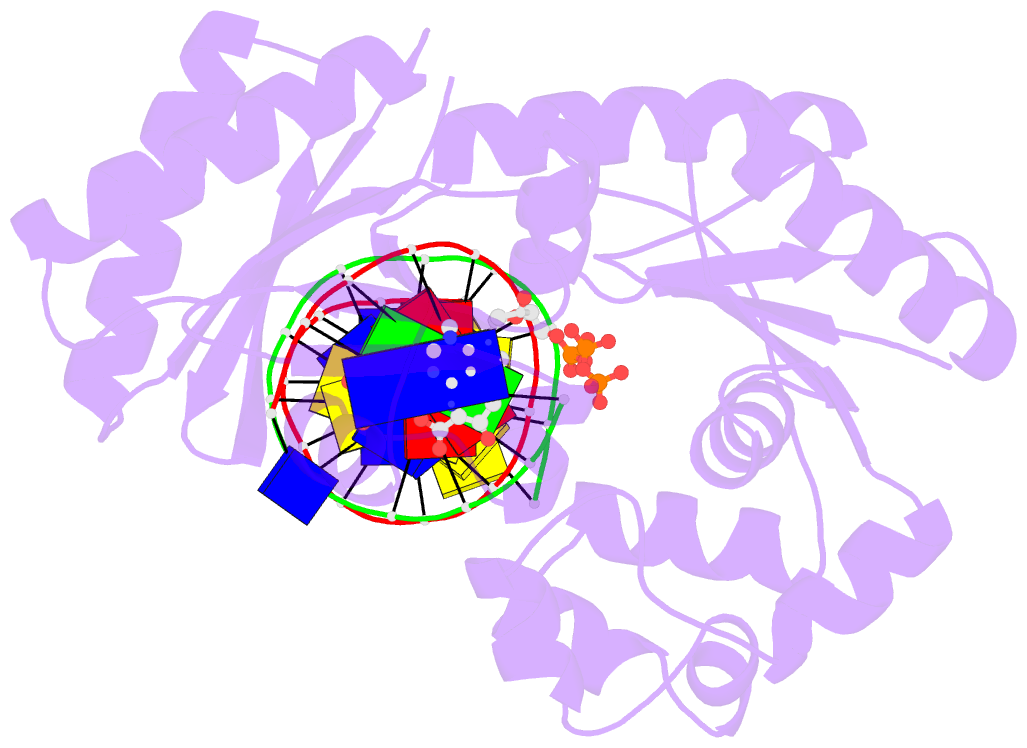
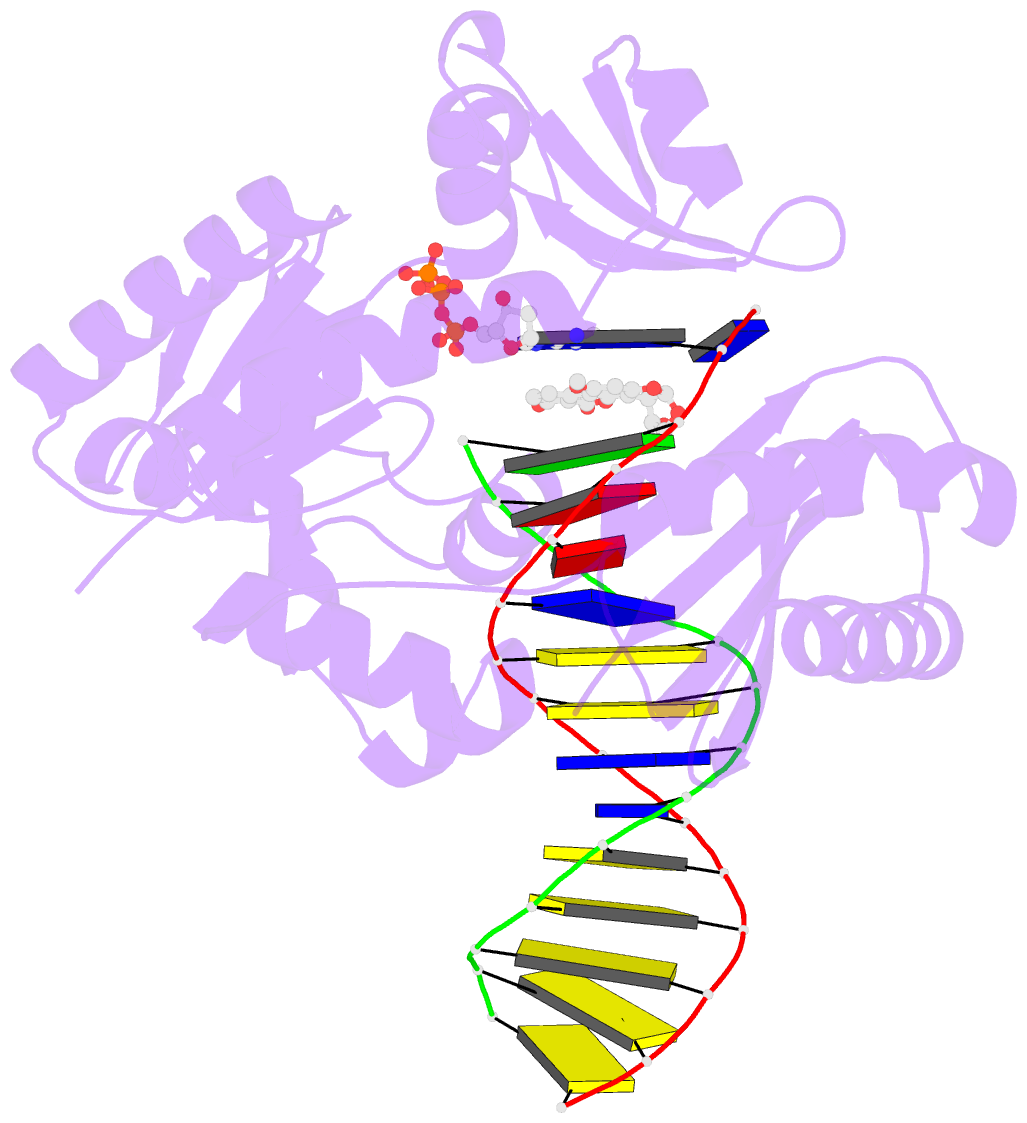
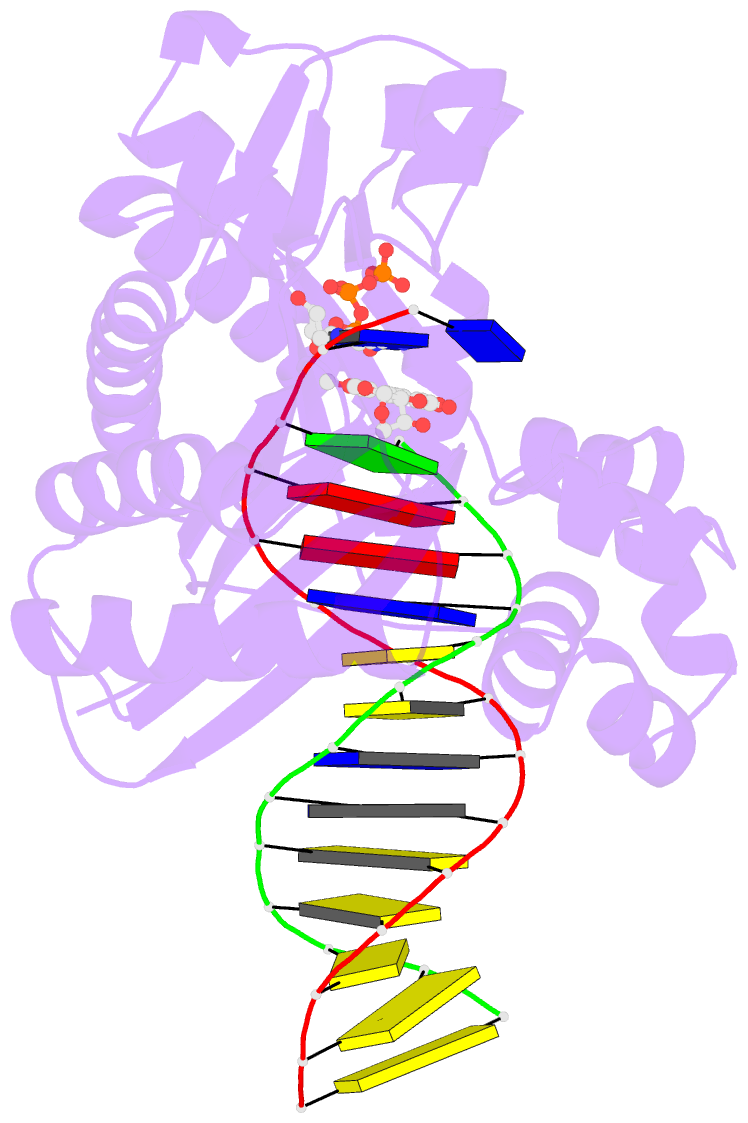
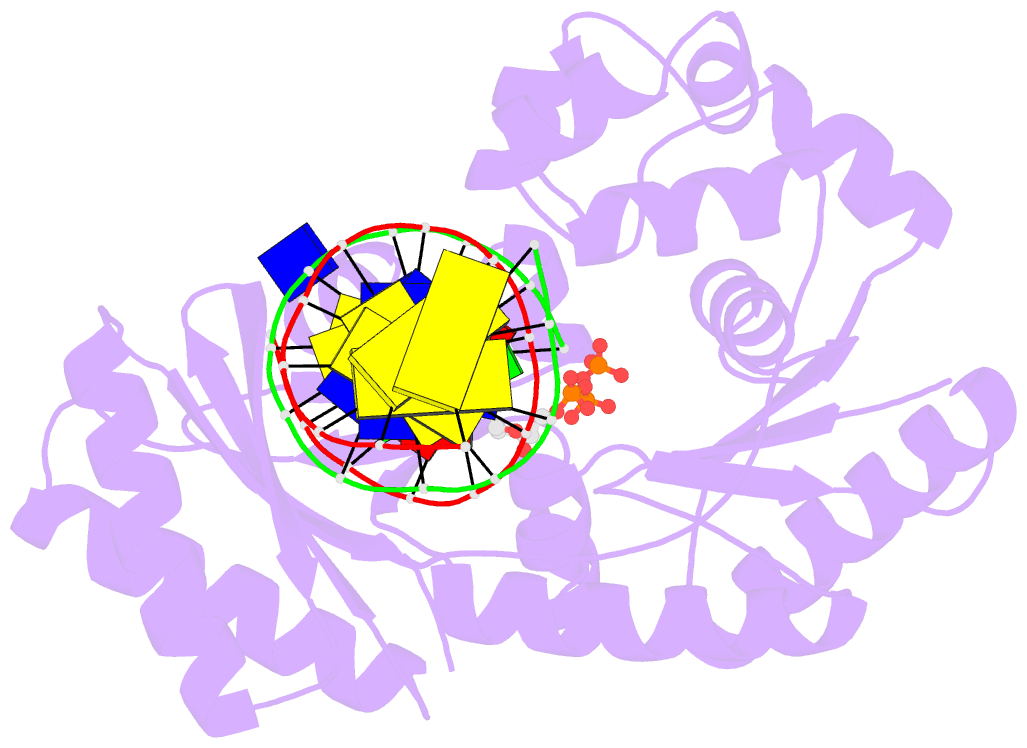
- Ternary complex of aflatoxin b1 adduct modified DNA
(afb1-n7-gua) with DNA polymerase iv and incoming datp
- Reference
-
Banerjee S, Brown KL, Egli M, Stone MP (2011): "Bypass of
Aflatoxin B(1) Adducts by the Sulfolobus solfataricus DNA
Polymerase IV." J.Am.Chem.Soc.,
133, 12556-12568. doi: 10.1021/ja2015668.
- Abstract
- Aflatoxin B(1) (AFB(1)) is oxidized to an epoxide in
vivo, which forms an N7-dG DNA adduct (AFB(1)-N7-dG). The
AFB(1)-N7-dG can rearrange to a formamidopyrimidine
(AFB(1)-FAPY) derivative. Both AFB(1)-N7-dG and the
β-anomer of the AFB(1)-FAPY adduct yield G→T transversions
in Escherichia coli, but the latter is more mutagenic. We
show that the Sulfolobus solfataricus P2 DNA polymerase IV
(Dpo4) bypasses AFB(1)-N7-dG in an error-free manner but
conducts error-prone replication past the AFB(1)-FAPY
adduct, including misinsertion of dATP, consistent with the
G→T mutations observed in E. coli. Three ternary
(Dpo4-DNA-dNTP) structures with AFB(1)-N7-dG adducted
template:primers have been solved. These demonstrate
insertion of dCTP opposite the AFB(1)-N7-dG adduct, and
correct vs incorrect insertion of dATP vs dTTP opposite the
5'-template neighbor dT from a primed AFB(1)-N7-dG:dC pair.
The insertion of dTTP reveals hydrogen bonding between the
template N3 imino proton and the O(2) oxygen of dTTP, and
between the template T O(4) oxygen and the N3 imino proton
of dTTP, perhaps explaining why this polymerase does not
efficiently catalyze phosphodiester bond formation from
this mispair. The AFB(1)-N7-dG maintains the
5'-intercalation of the AFB(1) moiety observed in DNA. The
bond between N7-dG and C8 of the AFB(1) moiety remains in
plane with the alkylated guanine, creating a 16°
inclination of the AFB(1) moiety with respect to the
guanine. A binary (Dpo4-DNA) structure with an AFB(1)-FAPY
adducted template:primer also maintains 5'-intercalation of
the AFB(1) moiety. The β-deoxyribose anomer is observed.
Rotation about the FAPY C5-N(5) bond orients the bond
between N(5) and C8 of the AFB(1) moiety out of plane in
the 5'-direction, with respect to the FAPY base. The
formamide group extends in the 3'-direction. This improves
stacking of the AFB(1) moiety above the 5'-face of the FAPY
base, as compared to the AFB(1)-N7-dG adduct. Ternary
structures with AFB(1)-β-FAPY adducted template:primers
show correct vs incorrect insertion of dATP vs dTTP
opposite the 5'-template neighbor dT from a primed
AFB(1)-β-FAPY:dC pair. For dATP, the oxygen atom of the
FAPY formamide group participates in a water-mediated
hydrogen bond with Arg332. The insertion of dTTP yields a
structure similar to that observed for the AFB(1)-N7-dG
adduct. The differential accommodation of these AFB(1)
adducts within the active site may, in part, modulate
lesion bypass.