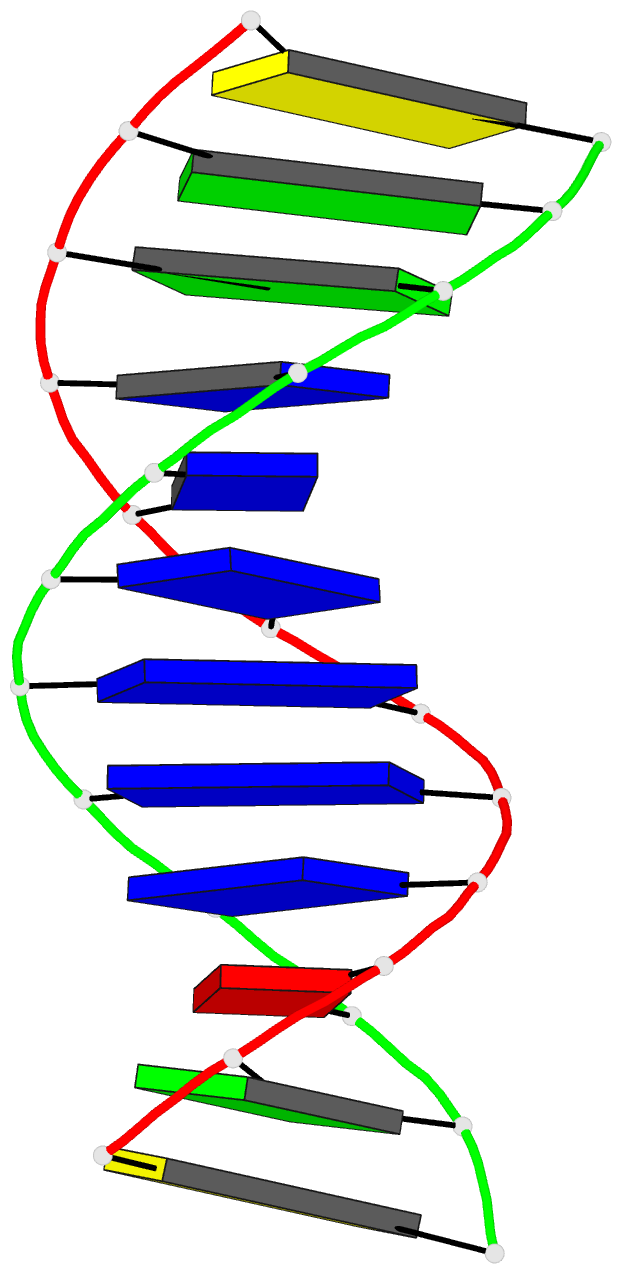
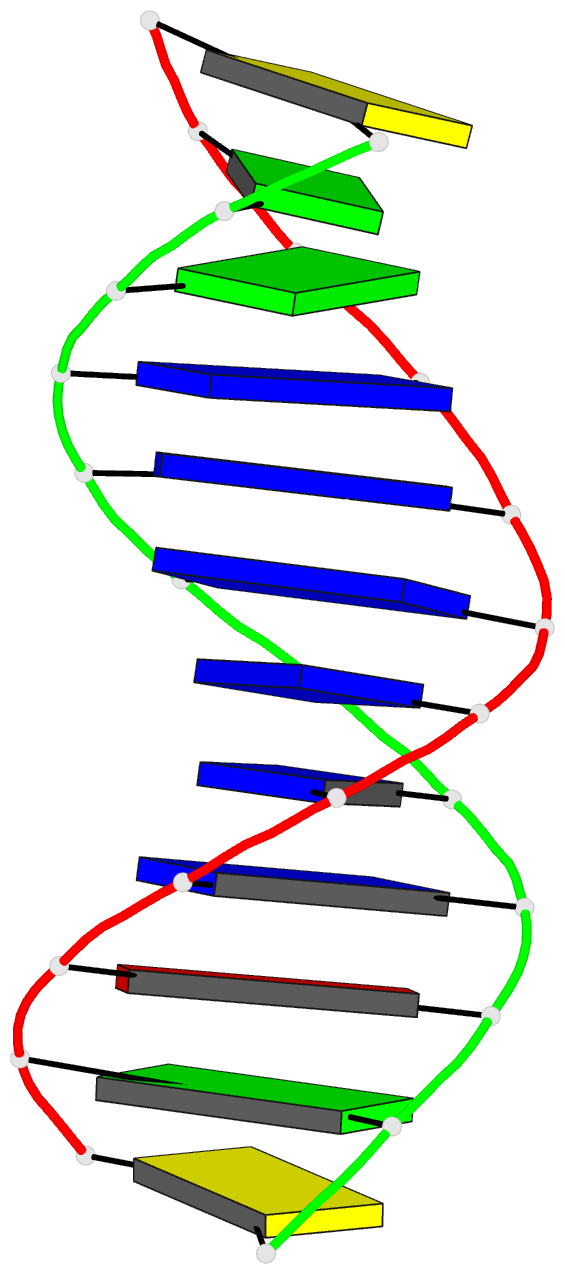
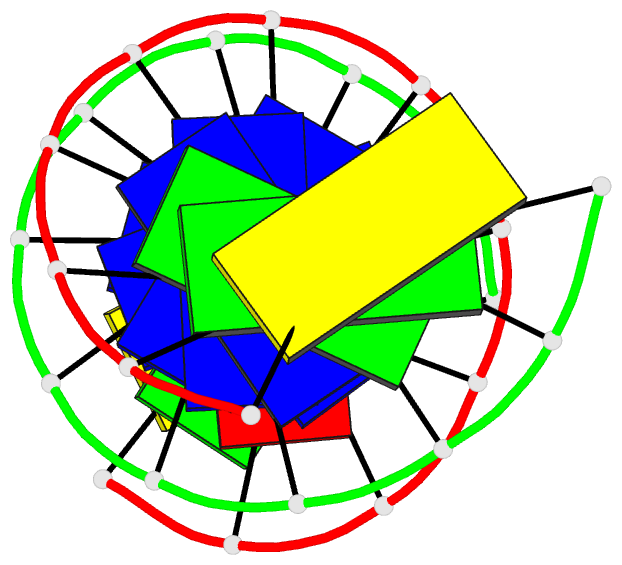
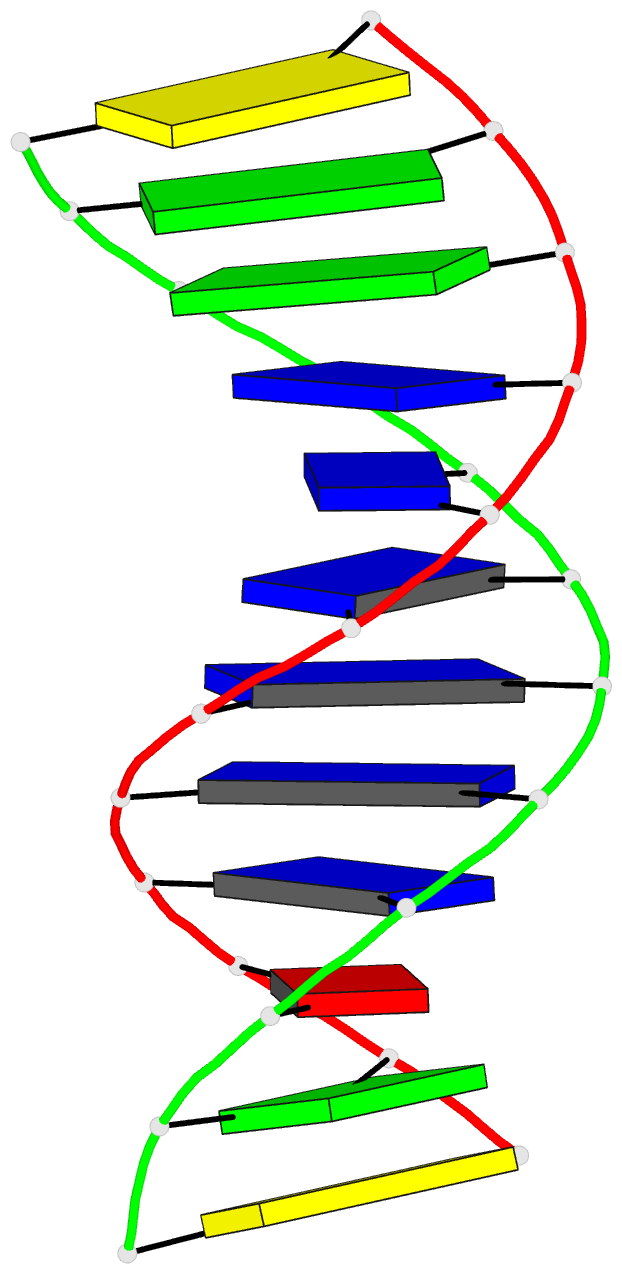
Summary information and primary citation
- PDB-id
-
5uzf;
DSSR-derived features in text and
JSON formats
- Class
- DNA
- Method
- NMR
- Summary
- Insights into watson-crick-hoogsteen breathing dynamics
and damage repair from the solution structure and dynamic
ensemble of DNA duplexes containing m1a - a6-DNA
structure
- Reference
-
Sathyamoorthy B, Shi H, Zhou H, Xue Y, Rangadurai A,
Merriman DK, Al-Hashimi HM (2017): "Insights
into Watson-Crick/Hoogsteen breathing dynamics and damage
repair from the solution structure and dynamic ensemble
of DNA duplexes containing m1A." Nucleic Acids
Res., 45, 5586-5601. doi: 10.1093/nar/gkx186.
- Abstract
- In the canonical DNA double helix, Watson-Crick (WC)
base pairs (bps) exist in dynamic equilibrium with sparsely
populated (∼0.02-0.4%) and short-lived (lifetimes ∼0.2-2.5
ms) Hoogsteen (HG) bps. To gain insights into transient HG
bps, we used solution-state nuclear magnetic resonance
spectroscopy, including measurements of residual dipolar
couplings and molecular dynamics simulations, to examine
how a single HG bp trapped using the N1-methylated adenine
(m1A) lesion affects the structural and dynamic properties
of two duplexes. The solution structure and dynamic
ensembles of the duplexes reveals that in both cases, m1A
forms a m1A•T HG bp, which is accompanied by local and
global structural and dynamic perturbations in the double
helix. These include a bias toward the BI backbone
conformation; sugar repuckering, major-groove directed
kinking (∼9°); and local melting of neighboring WC bps.
These results provide atomic insights into WC/HG breathing
dynamics in unmodified DNA duplexes as well as identify
structural and dynamic signatures that could play roles in
m1A recognition and repair.