Summary information and primary citation
- PDB-id
-
8dx1;
DSSR-derived features in text and
JSON formats
- Class
- DNA
- Method
- X-ray (4.79 Å)
- Summary
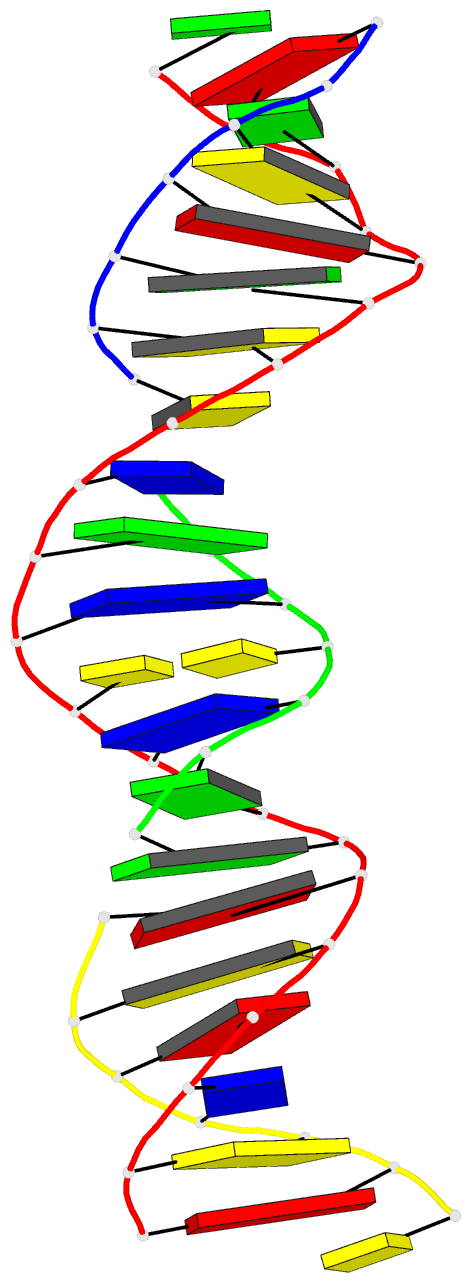
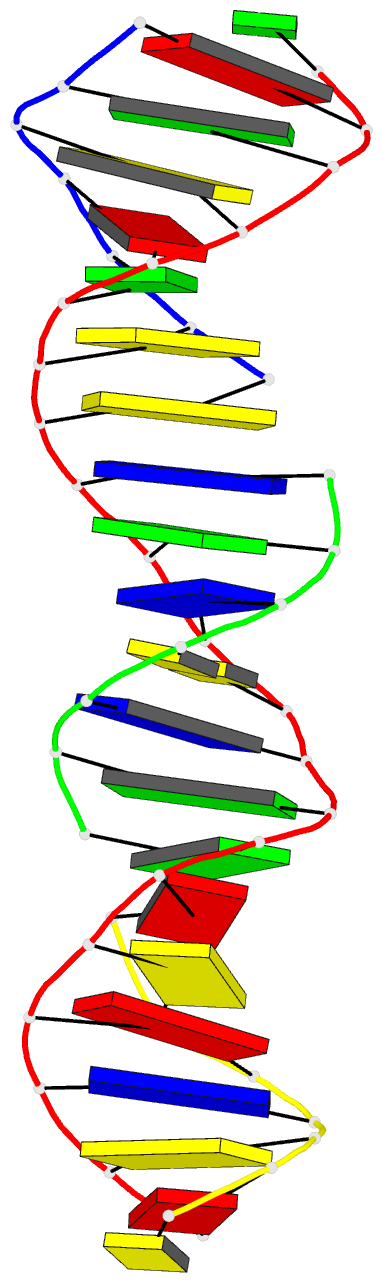
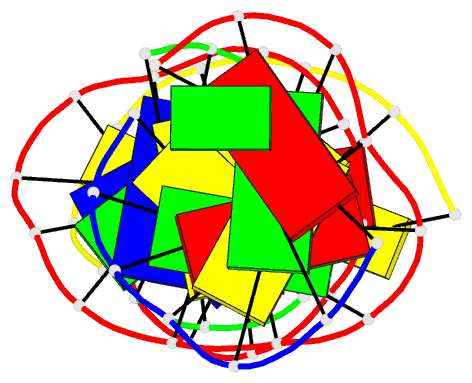
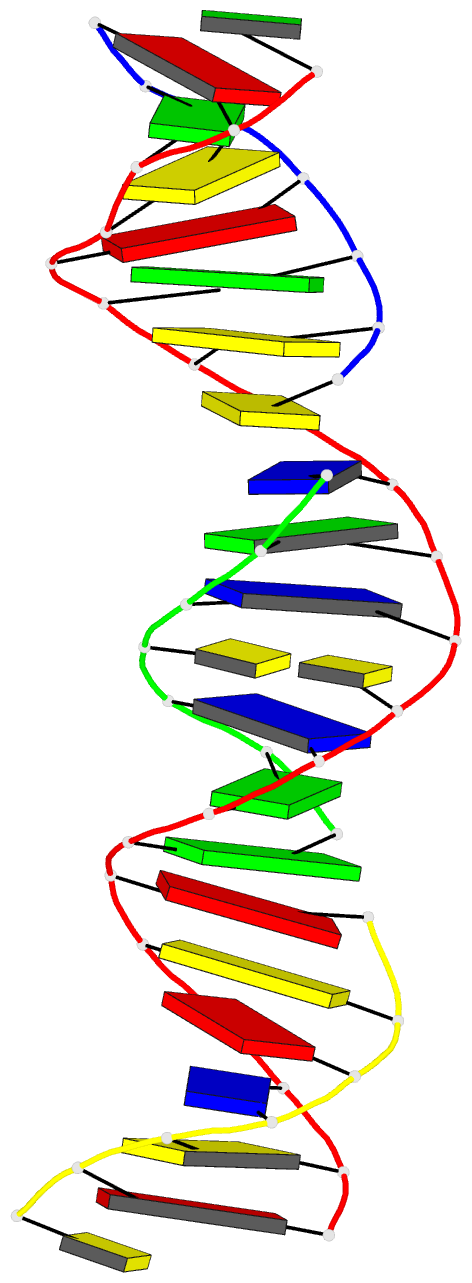
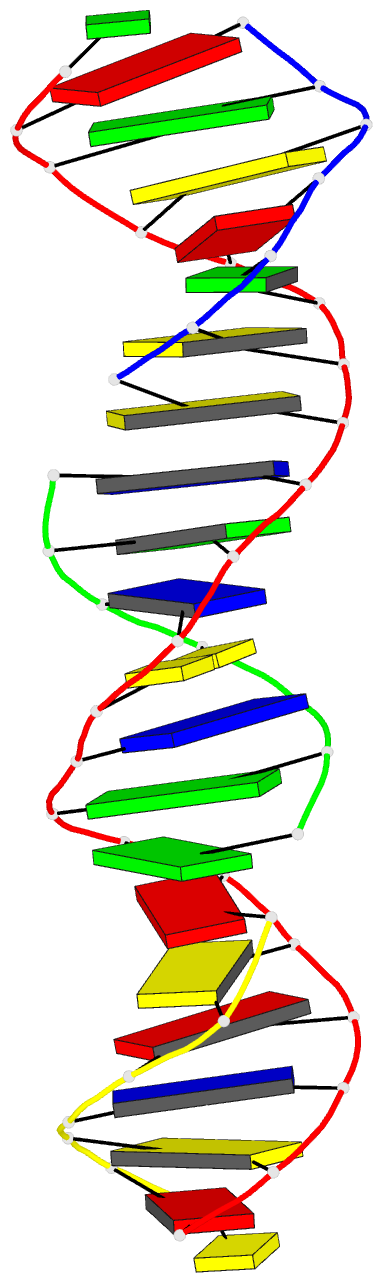
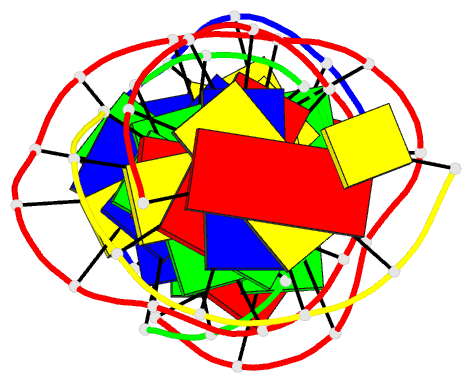
- [c:hg2+-ag+:c--ph 7 mops] metal-mediated DNA base pair
in tensegrity triangle in ag+ and hg2+ solution in
mops
- Reference
-
Lu B, Ohayon YP, Woloszyn K, Yang CF, Yoder JB,
Rothschild LJ, Wind SJ, Hendrickson WA, Mao C, Seeman NC,
Canary JW, Sha R, Vecchioni S (2023): "Heterobimetallic
Base Pair Programming in Designer 3D DNA Crystals."
J.Am.Chem.Soc., 145,
17945-17953. doi: 10.1021/jacs.3c05478.
- Abstract
- Metal-mediated DNA (mmDNA) presents a pathway toward
engineering bioinorganic and electronic behavior into DNA
devices. Many chemical and biophysical forces drive the
programmable chelation of metals between pyrimidine base
pairs. Here, we developed a crystallographic method using
the three-dimensional (3D) DNA tensegrity triangle motif to
capture single- and multi-metal binding modes across
granular changes to environmental pH using anomalous
scattering. Leveraging this programmable crystal, we
determined 28 biomolecular structures to capture mmDNA
reactions. We found that silver(I) binds with increasing
occupancy in T-T and U-U pairs at elevated pH levels, and
we exploited this to capture silver(I) and mercury(II)
within the same base pair and to isolate the titration
points for homo- and heterometal base pair modes. We
additionally determined the structure of a C-C pair with
both silver(I) and mercury(II). Finally, we extend our
paradigm to capture cadmium(II) in T-T pairs together with
mercury(II) at high pH. The precision self-assembly of
heterobimetallic DNA chemistry at the sub-nanometer scale
will enable atomistic design frameworks for more elaborate
mmDNA-based nanodevices and nanotechnologies.