Summary information and primary citation
- PDB-id
-
8ott;
DSSR-derived features in text and
JSON formats
- Class
- transcription
- Method
- cryo-EM (3.3 Å)
- Summary
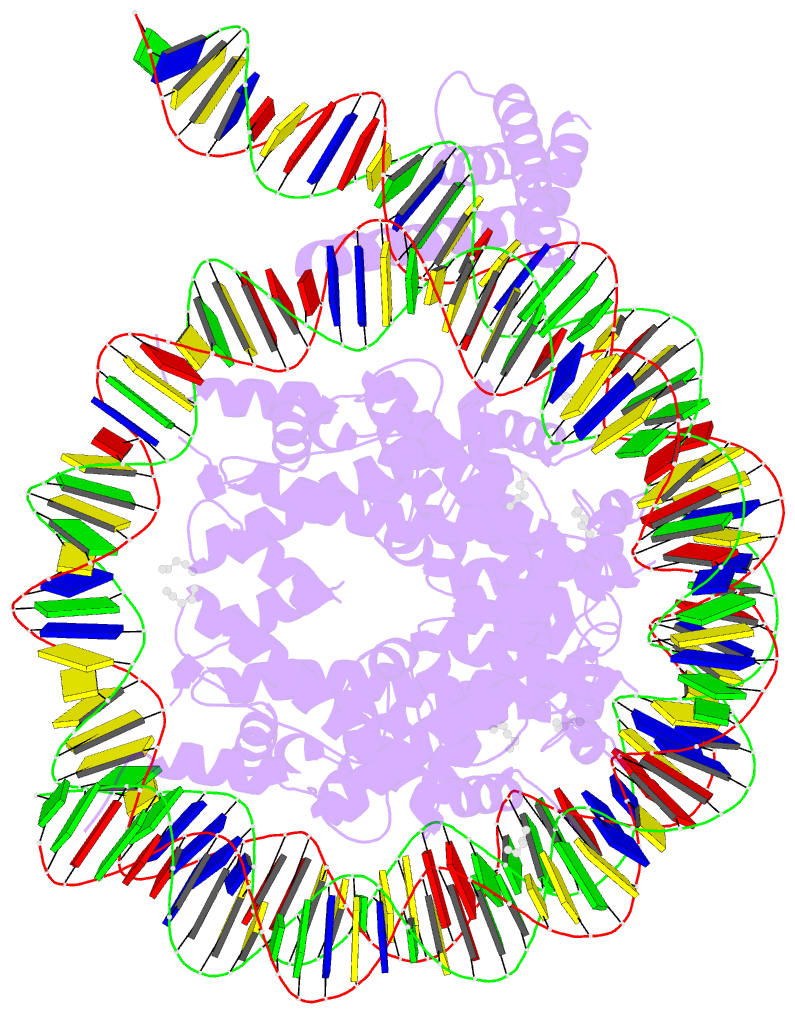
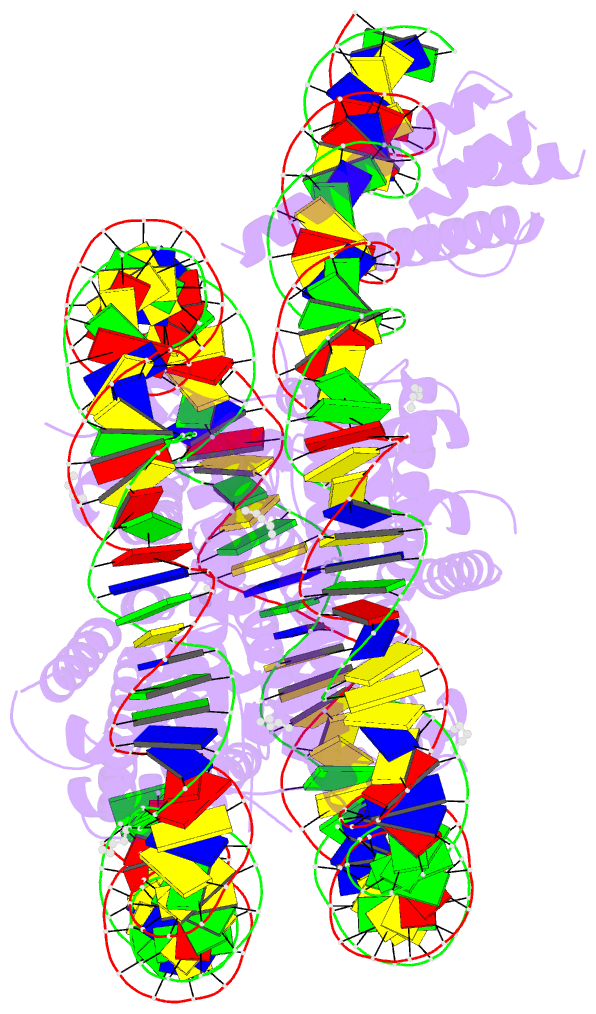
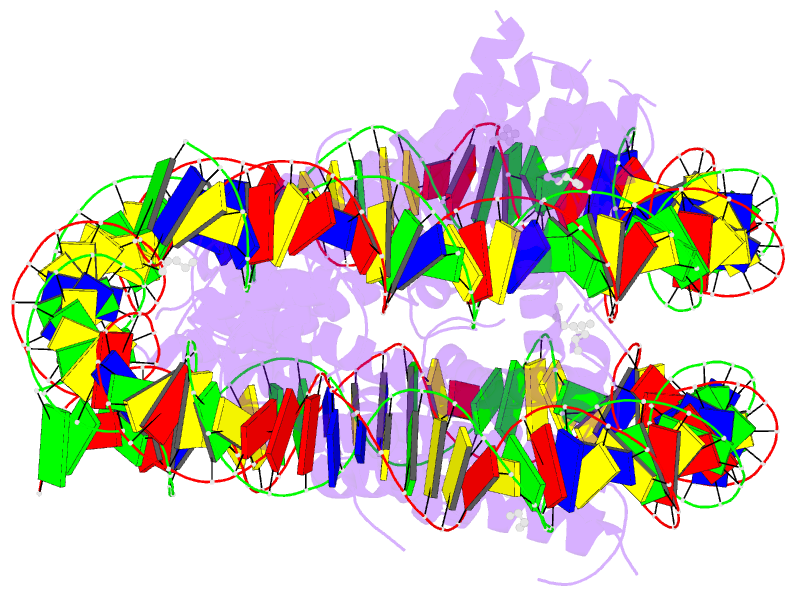
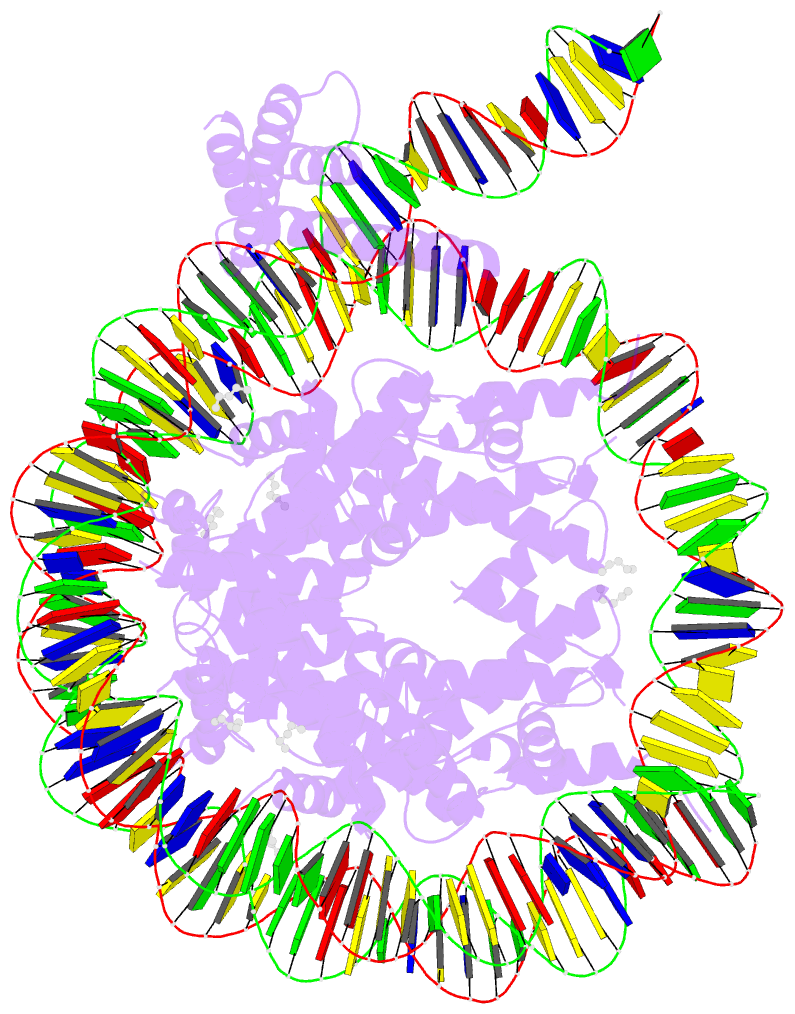
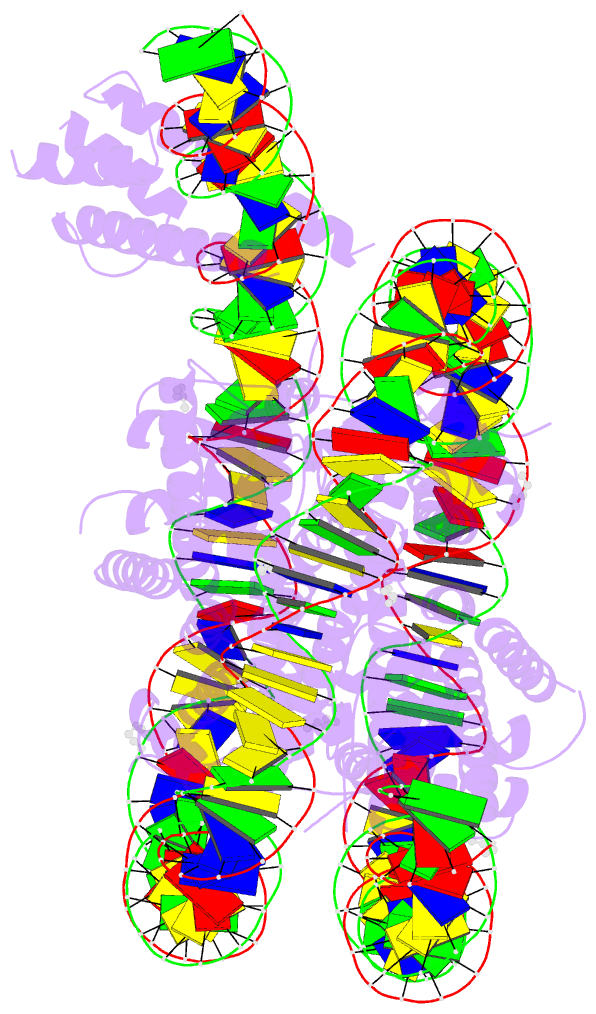
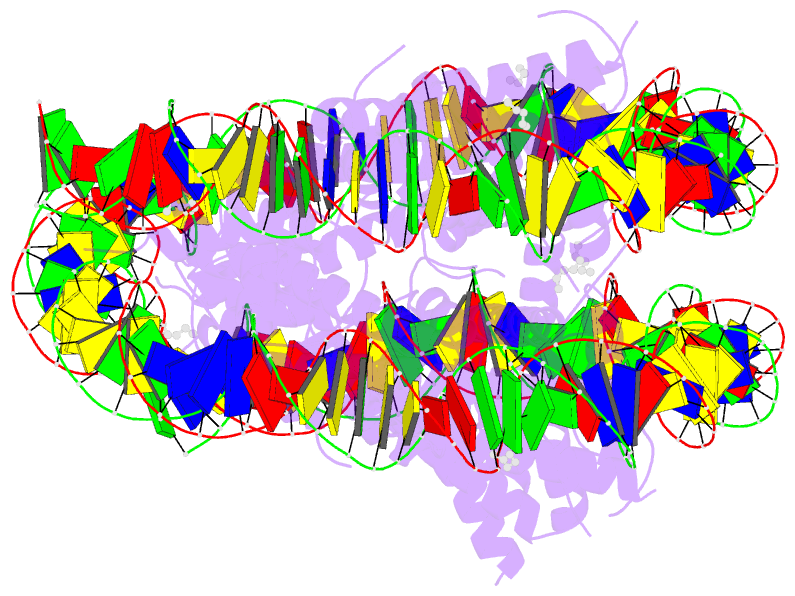
- Myc-max bound to a nucleosome at shl+5.8
- Reference
-
Michael AK, Stoos L, Crosby P, Eggers N, Nie XY,
Makasheva K, Minnich M, Healy KL, Weiss J, Kempf G,
Cavadini S, Kater L, Seebacher J, Vecchia L, Chakraborty
D, Isbel L, Grand RS, Andersch F, Fribourgh JL, Schubeler
D, Zuber J, Liu AC, Becker PB, Fierz B, Partch CL, Menet
JS, Thoma NH (2023): "Cooperation
between bHLH transcription factors and histones for DNA
access." Nature, 619,
385-393. doi: 10.1038/s41586-023-06282-3.
- Abstract
- The basic helix-loop-helix (bHLH) family of
transcription factors recognizes DNA motifs known as
E-boxes (CANNTG) and includes 108
members<sub>1</sub>. Here we investigate how
chromatinized E-boxes are engaged by two structurally
diverse bHLH proteins: the proto-oncogene MYC-MAX and the
circadian transcription factor CLOCK-BMAL1 (refs.
<sub>2,3</sub>). Both transcription factors
bind to E-boxes preferentially near the nucleosomal
entry-exit sites. Structural studies with engineered or
native nucleosome sequences show that MYC-MAX or
CLOCK-BMAL1 triggers the release of DNA from histones to
gain access. Atop the H2A-H2B acidic
patch<sub>4</sub>, the CLOCK-BMAL1 Per-Arnt-Sim
(PAS) dimerization domains engage the histone octamer disc.
Binding of tandem E-boxes<sub>5-7</sub> at
endogenous DNA sequences occurs through direct interactions
between two CLOCK-BMAL1 protomers and histones and is
important for circadian cycling. At internal E-boxes, the
MYC-MAX leucine zipper can also interact with histones H2B
and H3, and its binding is indirectly enhanced by OCT4
elsewhere on the nucleosome. The nucleosomal E-box position
and the type of bHLH dimerization domain jointly determine
the histone contact, the affinity and the degree of
competition and cooperativity with other nucleosome-bound
factors.